Friday, November 22, 2019

How To Construct A Corrosion Resistant Building in Central India

To understand how to make a building or structure resistant to corrosion, you have to first understand how corrosion happens and its impact on the structure.

How Do RCC Structures Corrode?
In a concrete building, the corrosion hits the steel parts of the structure. As we know, rust occurs when iron or an iron alloy (such as steel) is exposed to moisture or oxygen for a sustained duration.


Read more on at https://moirasariya.com/how-to-construct-a-corrosion-resistant-building-in-central-india/

Friday, October 18, 2019

How Earthquake Resistant TMT Bars Prevent Structural Damage

Several parts of India are excessively earthquake-prone. In fact, the past few big earthquakes in the country (like the ones in Latur in 1993, Bhuj in 2001 and Kashmir in 2005) have been seared in our collective memories as incredibly tragic events.


Know more on at https://moirasariya.com/how-earthquake-resistant-tmt-bars-prevent-structural-damage/

Monday, September 16, 2019

Effects of Corrosion on TMT Bars and Building Structure

Corrosion of RCC structures is an on-going challenge for the whole construction industry. Every year the government spends millions in the maintenance of civil structures across the country. And almost all of it is to battle structural deterioration – of which corrosion is one of the main culprits!

Tuesday, August 20, 2019

TMT Bars Come In Many Varieties – Find Out Which One Best Fits Your Needs

TMT or Thermo-Mechanically Treated bars are the backbone of the modern construction industry – from simple homes to skyscrapers to bridges and underwater structures – no matter what is being constructed, dig a little, and you are bound to find TMT bars inside every concrete structure.


Originally shared at: https://moirasariya.com/tmt-bars-come-in-many-varieties-find-out-which-one-best-fits-your-needs/

Thursday, July 25, 2019

Earthquake Resistant TMT bars for central India’s seismic zones


It has been found that the most differentiating factor to survive earthquakes with least damage is the use of high-quality TMT bars which should stick to minimum requirements defined in IS 1786-2008.
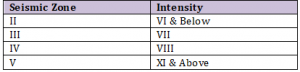
Based on scientific inputs for seismicity, earthquakes in the past and tectonic setup of the region, Bureau of Indian Standards (BIS) defined four seismic zones which mapping intensity levels of earthquakes:
Cities / towns in India majorly fall under Seismic Zones III, IV and V; and hence an increased focus on earthquake resistant construction in the country is need of the hour.
  • Zone V: The areas under zone V are most vulnerable to earthquakes; Entire northeastern India, parts of Jammu and Kashmir, Himachal Pradesh, Uttaranchal, Rann of Kutch in Gujarat, part of North Bihar and Andaman & Nicobar Islands. Read more...

Friday, June 21, 2019

Thermo Mechanically Treated Bars & Different Sariya Grades

Thermo Mechanically Treated Bars (TMT bars) are manufactured by treating them thermally through quenching, heating and finally compressing to form bars.
Quenching refers to a heat treatment in a quenching box where rebars are rapidly cooled using a special water spray system. This hardens the surface of TMT bar while the core still remains hot and soft. After quenching of the bar, self-tempering happens during which the heated core of the bar supplies heat to outer martensitic surface making tempered martensite. Post tempering, atmospheric cooling is done on cooling beds to get the ductile ferrite-pearlite structure of the core. 
Moira TMT bars are manufactured using the latest German “Thermex” technology. This technology involves exposing bars to temperature as high as 1100 degree Celsius, then passing through rolling mills and finally through high-pressure water which makes these bars cool outside and still heated at core inside on account of thermal exchange. This provides Moira TMT bar the characteristic property of having an inner soft core and a tougher outer core.
The grade of Steel is an important factor which governs the strength and durability of TMT bars. Moira TMT bars are high-quality bars using Fe-500, Fe-500 D, Fe-550, and Fe-550 D grades as per IS Code. Our bars are ranging from 8mm to 40mm diameter offering a wide variety as per the need and type to construction. Read more...

Earthquake Resistant TMT bars for central India’s seismic zones

It has been found that the most differentiating factor to survive earthquakes with least damage is the use of high-quality TMT bars which should stick to minimum requirements defined in IS 1786-2008.
Based on scientific inputs for seismicity, earthquakes in the past and tectonic setup of the region, Bureau of Indian Standards (BIS) defined four seismic zones which mapping intensity levels of earthquakes:
Cities / towns in India majorly fall under Seismic Zones III, IV and V; and hence an increased focus on earthquake resistant construction in the country is need of the hour.
  • Zone V: The areas under zone V are most vulnerable to earthquakes; Entire northeastern India, parts of Jammu and Kashmir, Himachal Pradesh, Uttaranchal, Rann of Kutch in Gujarat, part of North Bihar and Andaman & Nicobar Islands.
  • Zone IV: Remaining parts of Jammu and Kashmir and Himachal Pradesh, National Capital Territory (NCT) of Delhi, Sikkim, Northern Parts of Uttar Pradesh, Bihar and West Bengal, parts of Gujarat and portions of Maharashtra near west coast and Rajasthan. Read more...